
Resistance training
How maintaining strength can improve function and longevity
September 24, 2006
I’m always struck by the sheer strength and power of Olympic athletes. Watching them compete, it’s hard not to wonder what kind of training intensity their bodies must endure to perform at such extraordinary levels. Most of us could never sustain that kind of effort — and we don’t need to. But it raises a practical question: how much resistance training does the average person actually need, and does it offer real benefits for people who aren’t elite athletes?

Surprisingly, resistance training does more than build muscle. It supports general health, including cardiovascular health — something many of us associate only with aerobic exercise. One example comes from a study of nearly 4,300 adults aged 46 to 75. Participants were asked to lower themselves from standing to sitting on the floor, then rise back to standing, using as little arm support as possible. This “sitting‑rising test” (SRT) was scored from 0 to 10, with 10 indicating the ability to complete the movement smoothly and without assistance.
Over roughly 12 years of follow‑up, 665 participants died, many from cardiovascular causes. Among those who scored a perfect 10, fewer than 4% died during the study period. For people who scored an 8, the death rate tripled. And for those scoring between 0 and 4, the mortality rate exceeded 40%. The study doesn’t prove that improving strength directly increases longevity, but it strongly suggests that maintaining functional strength is tied to better long‑term health.
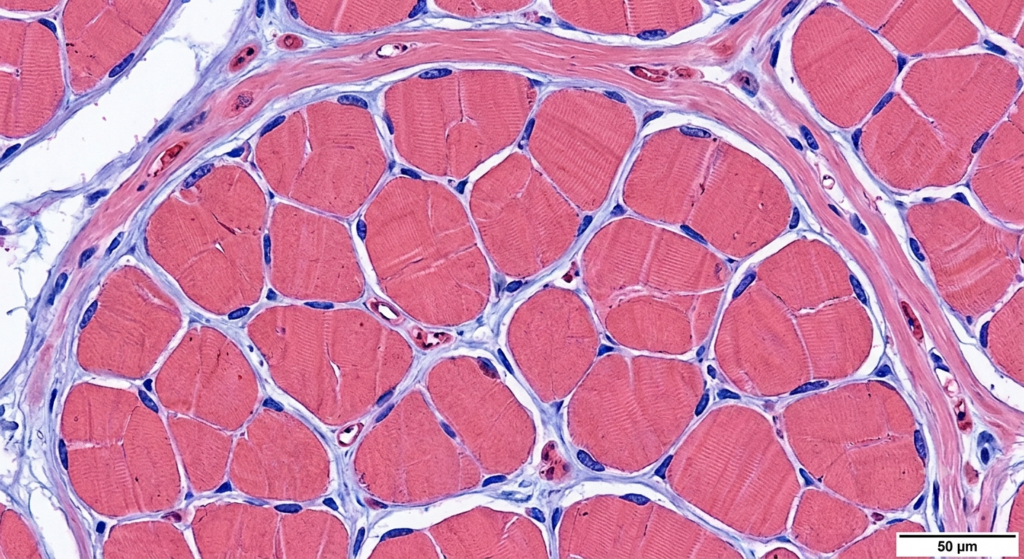
Muscle tissue under the microscope
Muscle itself is a remarkable tissue. It contracts and relaxes both voluntarily and reflexively, stabilizing joints and powering movement. Muscle fibers come in two main types: slow‑twitch (type I), which support endurance and postural stability, and fast‑twitch (type II), which generate quick, powerful movements. Different muscles contain different proportions of these fibers depending on their primary function. Strength is the capacity of a muscle to generate force — whether by resisting an external load, sustaining force across a distance to produce work, or maintaining effort over time to accomplish more physical power.
Strength = Force
Work = Force x Distance
Power = Work/Time
For years, people debated the “best” way to train — whether to focus on endurance, strength, muscle size, or power, and whether one approach was better than another to achieve certain training goals. Fortunately, modern research has simplified things. As noted above resistance training is fundamentally about making muscles work against an external force, whether that force is a weight, a resistance band, or simply your own body. Muscles can generate force while shortening (a concentric contraction) or lengthening (an eccentric contraction). Interestingly, eccentric contractions build strength even more effectively than concentric ones, though both are valuable. The main idea behind training is to work against a resistance that begins to feel difficult after 10-15 repetitions and that can be repeated for 2-3 cycles. It doesn’t require pushing iron until you collapse.

The equipment doesn’t need to be fancy. Weight machines at a gym work well, but so do dumbbells, ankle weights, elastic bands, or bodyweight exercises like squats and push‑ups. In other words, resistance training is accessible — it doesn’t require a gym membership. Training major muscle groups just two to three times per week is enough for meaningful benefit. A session or two with an athletic trainer can help you learn safe technique, and checking with a physician before starting a new program is always wise.
For older adults, the Centers for Disease Control and Prevention offers a helpful guide called Growing Stronger, which provides clear instruction on strength training to maintain functional independence.
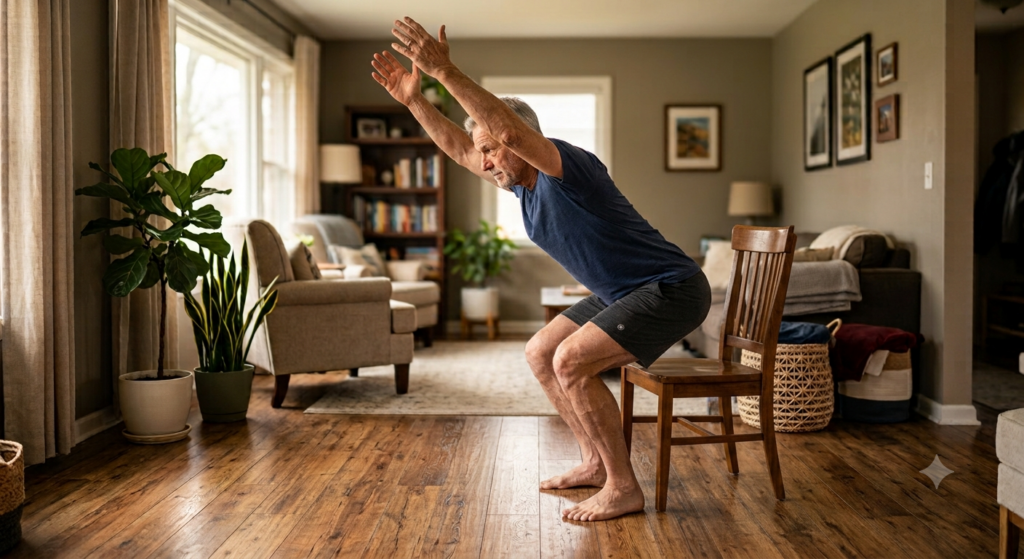
The benefits of resistance training extend far beyond building muscle mass. Because better strength leads to a higher capacity for work and builds power, it can improve walking speed, make lifting and carrying easier, enhance balance, and help with everyday tasks like rising from a chair or climbing stairs. As we age, staying flexible and strong becomes one of the most effective ways to preserve mobility and functional ability.
A small investment of time in resistance training can yield enormous returns — not just in strength, but in confidence, independence, and overall well‑being.